The Wrath of Cannes
 Johnny ReinschApril 5, 20267 min read
The regulators are cooking. And this week, they were cooking like the French, because the food in Cannes is so good it should be illegal. Fresh off the RWA Summit, this episode breaks down two massive regulatory developments that could reshape how tokenized securities trade and how stablecoins get issued in the US. We also unpack a provocative argument for vaults as qualified custodians, Gabe Shapiro's masterclass takedown of tokenized securities as they exist today, and the DeFi primitives that need to mature before we can bring real flow on-chain.
📈 RWA market cap was up 1% WoW to $27.6 billion
🏆 Biggest RWA winner: USDY added 10%, second week in a row as the top gainer
🏆 Biggest network winner: Ethereum creeping towards $16 billion in asset value
📈 Stablecoin market down slightly to $299.3 billion
🏆 Biggest stablecoin winner: DAI added $500M (yes, legacy DAI, not USDS)🏆 Biggest network winner: Ethereum
📈 Onchain risk free rates:
- Short term treasuries (1m): 3.68%
- Aave / DeFi: 3.11% (up from 3.03% last week)
RWA Summit Cannes Recap: DeFi Primitives and the Path to Demand
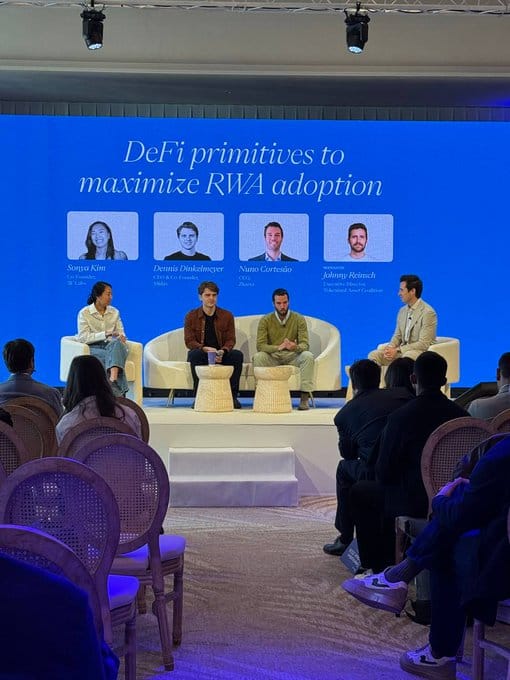
I was on the ground for two full days at RWA Summit in Cannes alongside ECC, and I can say without hesitation: if you're in the tokenized asset space and you attend one event a year, make it this one. The density of talent, C-suite executives, and protocol builders is unmatched. You can walk up to the heads of Aave, Euler, Centrifuge, or any number of protocols and just talk shop. The curation is phenomenal.
I moderated what I'm calling the most important panel (my quote, on the record) on DeFi primitives enabling RWA adoption. I had Sonia from 3F/Zarda and Dennis from Midas, who had just announced their $50 million Series A, congrats to that team.
The core narrative we unpacked: We've solved supply side. Everyone agrees on that. But what do we need on the demand side to actually move the needle? We're sitting at $25-30 billion in on-chain distributed tokenized assets. That's 0.001% of global securities that could be tokenized. We're fighting in a phone booth in New Jersey. So what primitives need to exist at the atomic unit level?
Liquidity as a Primitive
Everyone wants to do the loop trade. Buy a yielding tokenized asset, borrow against it, buy more, repeat. Works beautifully with ETH because the swap and lending markets are super liquid and you can unwind 15 loops in a single block. But try that with a quarterly-redemption private credit position where your average time to liquidity is 45 days, and suddenly unwinding is a very different story.
And there's the variable rate problem. If demand for Aave borrows goes parabolic, your cost of funds could spike 5X and your levered position gets liquidated. Structured term financing with interest rate certainty is a big unlock here.
Hedging and insurance on-chain is another primitive I'm watching closely. A lot of people are talking about it. I think it's going to be a big next move for DeFi.
And the question I posed that split the panel: Who is the end user? A human or a machine? Two said human, one said machine. I tend to agree with Charlie that end state is clearly machines, but the human sets the investment policy and the agent executes within those constraints. The robo-advisor of the future is an agent running vault strategies that conform to your risk appetite. Both answers are right, they're just describing different layers.
The path to a trillion isn't more leverage for power users. It's these primitives becoming so reliable that they power the products under the hood of fintechs and neobanks that serve everyday people. Stablecoins at $300 billion are creating a base layer, and as more users stay in stablecoins, we can close the loop on credit products funded in and paid back in stablecoins, opening new avenues for DeFi interaction through those customers.
SEC Innovation Exemption: DeFi Protocols May Trade Tokenized Securities
This one made me jump out of my seat on the airplane. The SEC has signaled it will release an innovation exemption focused on the Securities Exchange Act of 1934, which governs trading and market structure. That's the 34 Act, covering things like Reg ATS, NMS, and broker-dealer registration.
Why this matters: An innovation exemption on the trading side could mean DeFi protocols like Uniswap or Orca get a defined period to facilitate trading of tokenized securities without having to register as an ATS or broker-dealer. I had already started flipping my mental model toward expecting these protocols to apply for BD or ATS registration. Seeing this was a total surprise.
I've been doing extensive outreach with the SEC's Crypto Task Force and every time we discussed DeFi trading venues, I hit a wall. No clear signal on what to expect. This exemption is a major signal and it wasn't what anyone was expecting. Most of us anticipated an innovation exemption on the 33 Act (issuance) side, not trading.
There will likely be guardrails, probably around who can LP and what the sandbox parameters look like. But the principle is huge: self-custody and DeFi should coexist alongside the intermediated financial system. The intermediated side with brokers, insurance, and advice serves a great purpose. But the self-custody side drives experimentation and innovation. Both should exist, and this is a big step in that direction.
Treasury Department Issues First Genius Act Regulatory Proposal
The Treasury Department issued its first regulatory proposal implementing the Genius Act for US stablecoins. The key takeaway: if you're issuing a stablecoin under $10 billion, you can choose which state regulator oversees you, as long as that state's framework is substantially similar to the federal requirements. Go above $10 billion and you're automatically in OCC territory.
This opens the door for regional, dollar-backed stablecoins that are Genius-compliant. Imagine a $1 billion market cap stablecoin with local defensibility and innovation tailored to a specific economy, regulated by a state like Wyoming that already has strong crypto-forward UCC clarifications. That's a great business.
Most massive issuers will opt into the OCC charter out of the gate, but this preserves the ability for smaller, innovative issuers to exist and be compliant. Very clarifying, very good for the industry.
Also worth noting: the FDIC put out guidance clarifying that stablecoins will not get deposit insurance, which was expected.
VEDA's Letter to the SEC: Vaults as Qualified Custody
I sat next to Tuong Vy Le, VEDA's General Counsel, at the RWA Summit VIP dinner. VEDA published a letter asking the SEC to establish that vaults could qualify as qualified custody under Rule 206(4)-2, the rule that requires RIAs to hold client assets with a qualified custodian.
The rule was designed to prevent three things: misappropriation of funds, commingling of assets, and insolvency exposure. VEDA's argument is that a vault is actually an elegant way to accomplish all three of those policy objectives because the code itself performs the custodian's function.
I love this argument. If you can set up a vault that functions as a qualified custodian, an RIA could use it to run strategies with enhanced settlement times, faster redemptions, and collapsed infrastructure. You take what today requires multiple disparate intermediaries and collapse it into one core primitive that does what it's supposed to do.
This could also be a convergence point between the intermediated and self-custody financial systems. An individual could allocate into an RIA-managed vault through self-custody, while another RIA or robo-advisor allocates into the same vaults at scale. Both systems working together.
Charlie made a great point that this could lead to a collapsing of structures between what wealth managers do and what ETFs do, since at the end of the day they're running the same basic function with different strategies. Imagine customized target-date portfolios at Vanguard-level fee structures instead of the 50 basis points robo-advisors charge today.
One data point that came up repeatedly at the Summit: vault curators need skin in the game. In the hedge fund world, the GP typically invests a meaningful amount of their net worth alongside LPs. If a curator has zero skin in the game, their only incentive is AUM-maxing and fee-maxing. If things blow up, they walk away. I get very nervous about that. The chess move for an RIA like Fidelity or Franklin would be to curate a vault and wrap it in fund protections. That would immediately make every non-fiduciary curator look very, very uncompetitive.
Gabriel Shapiro's Tokenized Securities Takedown
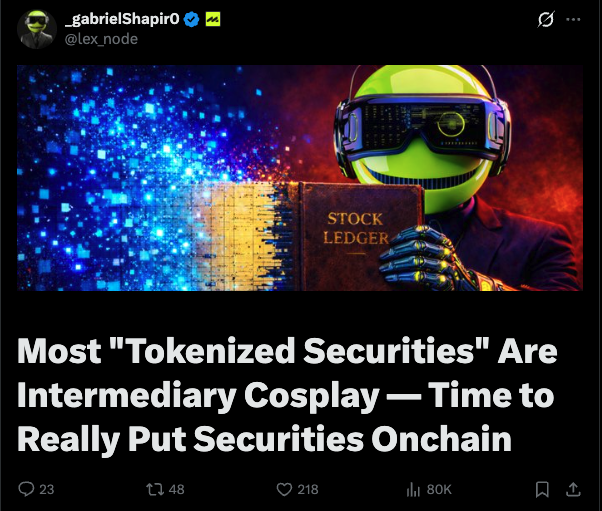
Gabe Shapiro from Lex Node published what I described on-air as an "absolute pwn" of tokenized securities. His core argument: every form of tokenized securities introduced so far, other than his own project MetaLex, has merely added a messaging layer on top of the underlying security rather than creating true digital-native ownership.
He's largely right. The layers of regulation from states, the SEC, FINRA, the UCC, and Delaware corporate law create a complex mapping problem when you try to fit an exogenous asset onto a permissionless network and then layer compliance on top. Things like shareholder inspection rights, which exist so you can audit a vote, are really purposeful rules that don't map cleanly to how most token implementations work today.
Where I'd hedge: I think the efforts from teams like Securitize and Figure are genuinely moving toward digitally-native issuance. DGCL already has provisions for electronic shareholder ledgers. Wyoming and Bermuda have similar frameworks. Everyone is building toward where the puck is going. Maybe they haven't fully breached it yet, but the direction is clear.
I also think we need securities-optimized chains, similar to what Tempo is doing for stablecoins. Different asset classes may need purpose-built networks where the validator set can prove compliance-relevant data as part of validating transactions. Avalanche is already moving in this direction with a focus on private credit infrastructure.
Read the full piece. It's a masterclass primer on how to make a security actually live on-chain.
Shout Outs
Congrats to Valinor on their $25 million seed led by Castle Island Ventures. Connor and Lily are building blockchain-powered private credit infrastructure, and the investor roster is a veritable who's who. Excited to see where this goes.
Also a shoutout to the Midas team on their $50 million Series A for their tokenized investment platform. Dennis and the team have been doing great work.
Watch or listen to the full episode on Spotify.
![[███░░░░]: Robinhood Chain Goes Live, Stablecoins Hit $300B, and the Clarity Act Countdown Resets](/_next/image?url=https%3A%2F%2Fstorage.ghost.io%2Fc%2Fdf%2F2c%2Fdf2c7059-8617-4d25-9617-996aea279325%2Fcontent%2Fimages%2F2026%2F07%2FProgress-Bar-1.jpg&w=3840&q=75)