Welcome to the Newest Members of the Tokenized Asset Coalition
Twelve new members join TAC, and a look back at a year that changed what the market can build.
 Johnny ReinschOctober 15, 20264 min read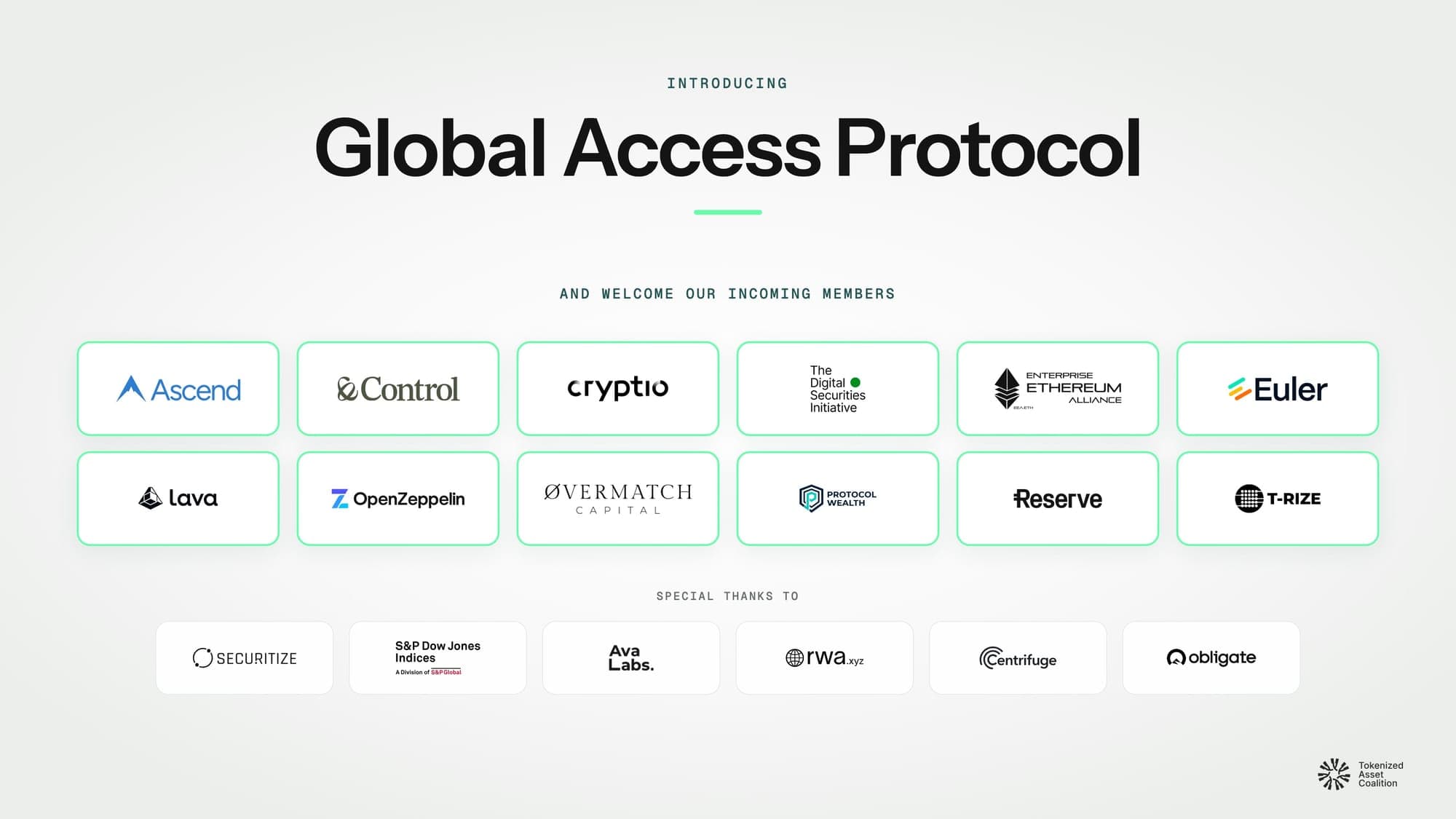
Today we're welcoming twelve new members to the Tokenized Asset Coalition. Before introducing them, it's worth looking at how much has changed since our last cohort.
A different year
A year ago, about $25 billion in real-world assets was distributed onchain. Today it's more than $39 billion, up 54%. The Research Hub didn't exist before June 2025. Today it has more than 6,400 readers, including over 300 at traditional financial institutions and 48 at regulators and policy bodies.
The bigger change came from regulators. Over the past twelve months:
- The CFTC cleared tokenized assets like Treasuries and money market funds to serve as collateral for futures and swaps (December 2025), then followed up with FAQs in March and September.
- SEC staff published a statement on tokenized securities, confirming that a security is still a security whether its ownership is recorded on a blockchain or a traditional ledger (January).
- SEC staff said that non-custodial DeFi and wallet front ends, including those for tokenized equities and debt, can operate without registering as broker-dealers, subject to conditions (April).
- The SEC proposed letting a distributed ledger serve as the official record of securities ownership (September 1).
- The SEC issued an innovation exemption opening a five-year path for tokenized stock to trade onchain (September 17).
A year ago, most of the hard questions in tokenization were legal ones. Today many have answers, and the remaining work is building markets that operate within those answers.
What you told us
When we published the State of Tokenization 2026, we asked you what was most top of mind. No surprise, demand came first: 71% of respondents named access to institutional distribution and 68% named retail. Regulatory clarity followed at 55%, and about a third pointed to identity and KYC. Further down the list, a dedicated group flagged issues the industry tends to overlook, including security, quantum-resistant cryptography and estate planning.
Why this group
This cohort maps closely to that list. More on each of the individual projects below.
- Demand. Ascend is building lending against tokenized stock at a regulated broker-dealer. Euler gives tokenized assets a home in DeFi lending. Reserve, Protocol Wealth and Overmatch Capital connect onchain products with the investors and capital that need them. T-RIZE is a tokenization service on Canton, expanding our reach into an ecosystem that institutions are adopting quickly.
- Regulatory clarity and identity. The Digital Securities Initiative and the Enterprise Ethereum Alliance strengthen our research and policy work. DSI co-developed the Global Access Protocol with us to solve identity across issuers.
- Security and reliability. OpenZeppelin secures the contracts that most of onchain finance runs on, and Lava keeps blockchain data available when a single provider fails.
- Estate planning. Control makes sure digital wealth passes securely to the people it's meant for.
- Reporting. Cryptio turns onchain activity into auditable records that finance teams and auditors can rely on.
Meet the new members
Ascend: Ascend is a regulated broker-dealer building lending against tokenized NMS stock, letting investors borrow against tokenized equities the way they do against shares in a brokerage account. Its co-founder Dennis O'Connell is also president of the ERC3643 Association, whose standard underpins much of today's permissioned token issuance.
Control: Control builds private custody for individuals managing significant digital asset wealth, combining institutional-grade security with wealth services so holders keep full ownership of their assets. It also handles one of the most overlooked problems in crypto: making sure those assets pass securely to loved ones when the time comes.
Cryptio: Cryptio is the accounting and reporting layer for digital assets, turning onchain activity into records that finance teams and auditors can rely on. As tokenized assets move onto corporate and fund balance sheets, that audit trail becomes a requirement.
Digital Securities Initiative: The Digital Securities Initiative works on the research and policy questions that come with bringing securities onchain. Over the past year, DSI and TAC developed the Global Access Protocol together, through dozens of meetings with the SEC's Crypto Task Force and division staff, the CFTC, the Department of the Treasury and policy leaders across the industry.
Enterprise Ethereum Alliance: The Enterprise Ethereum Alliance is the member-driven standards organization for enterprise use of Ethereum. Its members include some of the largest financial and technology companies working on public and permissioned blockchains.
Euler: Euler is a modular lending protocol that lets builders launch and customize their own lending markets. That flexibility makes it a natural home for tokenized assets that need their own risk parameters and access rules.
Lava: Most applications get their blockchain data from a single RPC provider, so when that provider lags, rate-limits or goes offline, the application goes down with it. Lava routes each request in real time to the best-performing node across an open network of independent providers, with automatic failover, which removes that single point of failure for teams like tokenization platforms that can't afford downtime.
OpenZeppelin: OpenZeppelin's open-source contract libraries are the foundation much of the industry builds on: more than $38 trillion in value has moved through OpenZeppelin Contracts. Its audits secure many of the largest protocols in the space, and for tokenized securities, where a contract bug is a securities problem, that work is essential.
Overmatch Capital: Overmatch Capital is an advisory and principal investing firm for the changing financial services landscape. It advises companies on debt capital markets, M&A and structured credit, with a focus on digital assets and digitally native cash flows.
Protocol Wealth: Protocol Wealth is an SEC-registered investment adviser specializing in digital asset wealth management. It serves protocol founders, ultra-high-net-worth investors and institutional allocators, combining traditional wealth planning with onchain expertise.
Reserve: Reserve builds onchain index products that give investors diversified exposure through a single token. Co-founder Nevin Freeman is co-creator of the Global Access Protocol.
T-RIZE: T-RIZE provides institutional tokenization infrastructure for bonds, ETFs, funds, real estate and commodities. It builds on the Canton Network, bringing TAC into one of the fastest-growing ecosystems for regulated markets.
Thank you
Thank you to our returning members Ava Labs, Obligate, S&P Dow Jones Indices and Securitize, and to our partners Centrifuge and RWA.xyz. Thank you also to every member and alumni organization that helped TAC through its first year. If you came on the podcast, contributed research or picked up the phone when we needed help, this includes you.
One more thing
Today we also unveiled the Global Access Protocol (GAP), a framework for making tokenized securities composable in DeFi. We've spent a year building it with the Digital Securities Initiative and in meetings with the SEC, CFTC and Treasury. We'll share more next week. In the meantime, read the framework here.
You can read the full press release here.
Onward,
Johnny Reinsch
Executive Director, Tokenized Asset Coalition
![[███░░░░]: The First Federal Crypto Market Structure Rule, Tokenized Stocks Go Mainstream, and USDO Goes Live](/_next/image?url=https%3A%2F%2Fstorage.ghost.io%2Fc%2Fdf%2F2c%2Fdf2c7059-8617-4d25-9617-996aea279325%2Fcontent%2Fimages%2F2026%2F10%2FProgress-Bar-3.jpg&w=3840&q=75)